
Focus on What Matters Most. Before It Matters Most.
Building an agentic strategy for customer retention and growth.

Frank Ricciardi
Founder & Principal Advisor
For years, companies have invested heavily in understanding their customers.
- We implemented CRM platforms.
- Customer Success platforms.
- Product analytics.
- Support systems.
- Call intelligence.
- Finance platforms.
- Business intelligence.
- Data warehouses.
We built health scores, dashboards, alerts, playbooks and increasingly sophisticated customer journeys.
And yet, ask an Account Manager or Customer Success Manager how much of their week is spent actually understanding customers, helping them realize value and deepening relationships, versus finding information, reconciling data, researching accounts, preparing for meetings, updating systems, building presentations, coordinating internal resources and chasing follow-up.
The answer reveals the problem.
We have given customer-facing teams more systems.
We have not necessarily given them more intelligence.
Artificial intelligence creates an opportunity to change that.
But only if we resist the temptation to put a chatbot on top of the existing Customer Success technology stack and call it transformation.
The opportunity is much bigger.
This is not a chatbot
Conversational AI can absolutely be useful. A Customer Success Manager should be able to ask:
What has changed at this customer since I last spoke with them?
Prepare me for my meeting with the CFO tomorrow.
What commitments did we make during the last QBR?
Where are we seeing adoption decline?
What evidence do we have that the customer is realizing the value we promised?
Those capabilities are valuable.
But they are not an agentic Customer Success strategy.
A chatbot waits for someone to ask a question.
An agentic system is continuously working.
- It observes.
- Researches.
- Connects signals.
- Maintains context.
- Recognizes changes.
- Surfaces what matters.
- Collaborates with the human.
- Mobilizes resources.
- Tracks outcomes.
- Learns from feedback.
And, within appropriate guardrails, takes action.
That distinction matters because customer retention rarely fails on the day of renewal.
And expansion opportunities rarely begin when someone creates an opportunity in the CRM.
The signals usually appear much earlier.
The question is whether we recognize them before they matter most.
The problem is not a lack of data
Most established Customer Success organizations already possess extraordinary amounts of customer data.
The problem is that it is fragmented.
- Commercial history may sit in the CRM.
- Product utilization in an analytics platform.
- Support cases in another system.
- Invoices and payment behavior in finance.
- Contracts somewhere else.
- Meeting transcripts in a conversation intelligence platform.
- Implementation milestones in a project management system.
- Customer objectives in success plans or QBR presentations.
Executive relationships may exist partly in systems and partly in someone's memory.
And then there is everything happening outside the company's systems.
- A customer announces a restructuring.
- A new CFO arrives.
- The CEO changes strategy.
- The company makes an acquisition.
- A division is sold.
- Hiring accelerates in one area and contracts in another.
- A competitor enters the account.
- A regulatory change affects the customer's industry.
- An executive sponsor leaves.
- Earnings commentary reveals a new strategic priority.
- The customer announces a cost-reduction initiative.
These can all be meaningful customer signals.
But no human managing dozens of relationships can continuously monitor every internal and external source, connect every signal to historical context, determine which changes matter and still spend enough time doing the thing humans are uniquely positioned to do:
Build relationships.
From customer 360° to customer intelligence
For years, the industry has pursued the idea of the customer 360° view.
Bring customer information together. Put it on a dashboard. Give the CSM a complete view.
That was an important step.
But a complete view is not the same thing as intelligence.
A dashboard still requires a human to look at it. Interpret it. Connect one signal to another. Determine whether something has changed. Recall the relevant history. Decide whether the change matters. Research what might explain it. Determine who else should know. And decide what to do next.
An agentic system changes the model.
Instead of simply aggregating customer information, it can continuously interpret signals across systems and over time.
The evolution is:
The human becomes more important as we move from left to right.
Give the relationship owner super intelligence
The objective is not to replace the Account Manager or Customer Success Manager.
Quite the opposite.
The objective is to give them super intelligence before it matters most.
Imagine a system that continuously understands:
- Customer objectives and expected outcomes.
- Product adoption and utilization.
- Value realized.
- Support history.
- Sentiment.
- Commercial terms.
- Renewal timing.
- Stakeholder engagement.
- Executive relationships.
- Open commitments.
- Implementation progress.
- Financial behavior.
- Previous interventions.
- Expansion history.
And relevant changes occurring inside the customer's business and in the external market.
No individual could reasonably maintain that context across a significant portfolio of customers.
A system of agents can.
But that does not mean the system should make every decision.
Don't tell the CSM what to do
One of the easiest mistakes in designing these systems will be confusing intelligence with instruction.
Imagine an agent detects the following:
- Product utilization has declined over the last 60 days.
- Support escalations have increased.
- The executive sponsor recently changed roles.
- The customer has announced a company-wide cost-reduction initiative.
- The contract renews in nine months.
A simplistic AI system might respond:
Customer at risk. Schedule executive business review.
That is automation masquerading as intelligence.
The system does not know everything the CSM knows.
Perhaps adoption declined because the customer completed a seasonal initiative. Perhaps the new executive sponsor is someone the CSM has worked with before. Perhaps the cost-reduction initiative actually creates an opportunity because the product demonstrably reduces operating expense. Perhaps there is something else happening that none of the systems can see.
This is where I believe reverse prompting becomes powerful.
Instead of telling the CSM what to do, the system begins a conversation:
I am seeing several changes that may be relevant to this account. Product utilization is down 18% over 60 days, support escalations have increased, your executive sponsor has changed roles, and the company recently announced a cost-reduction program. What context do you have that might explain these signals?
Given what you know about the customer, which of these signals do you believe matters?
What outcome are you trying to create?
Now the agent can help.
- It can challenge assumptions.
- Retrieve additional evidence.
- Research the customer.
- Compare patterns with similar accounts.
- Recall previous conversations and commitments.
- Identify missing stakeholders.
- Model potential approaches.
- Help create an intervention plan.
- Prepare the relevant materials.
- Identify internal resources.
- Track commitments.
- Escalate when appropriate.
- And follow the situation over time.
The agent contributes intelligence. The human contributes judgment.
Together, they make a better decision.
This requires agents with jobs, not one AI that does everything
I do not believe the optimal architecture is one enormous Customer Success agent.
Customer retention and growth involve different kinds of work.
Different work requires different skills, data, instructions, permissions and guardrails.
Imagine an orchestrated system containing specialized agents:
A Customer Health Agent continuously evaluates meaningful changes in adoption, support, engagement, sentiment and other leading indicators.
A Value Realization Agent maintains the customer's intended business outcomes, identifies evidence of realized value and spots gaps between the promise and the result.
A Relationship Intelligence Agent understands stakeholders, champions, detractors, influence, engagement patterns and changes in the customer's organization.
An External Signals Agent monitors relevant developments in the customer's business and market.
A Renewal Intelligence Agent understands contracts, commercial terms, timing, historical negotiations, risks and dependencies.
An Expansion Intelligence Agent looks for relevant opportunities based on customer priorities, value already achieved, whitespace, organizational changes and unmet needs.
A Preparation Agent assembles the context required for QBRs, executive meetings, renewal discussions and other important lifecycle moments.
An Action and Follow-Through Agent tracks commitments, next steps and unresolved issues across the relationship.
And an Orchestration Agent determines what matters, connects insights across agents, assigns, manages, checks and aggregates the work of the agents, and prevents the CSM from being overwhelmed by a new generation of AI-generated noise.
That last job may be one of the most important.
We do not need to replace dashboard overload with agent overload.
The system should earn the human's attention.
Health scores can become much more intelligent
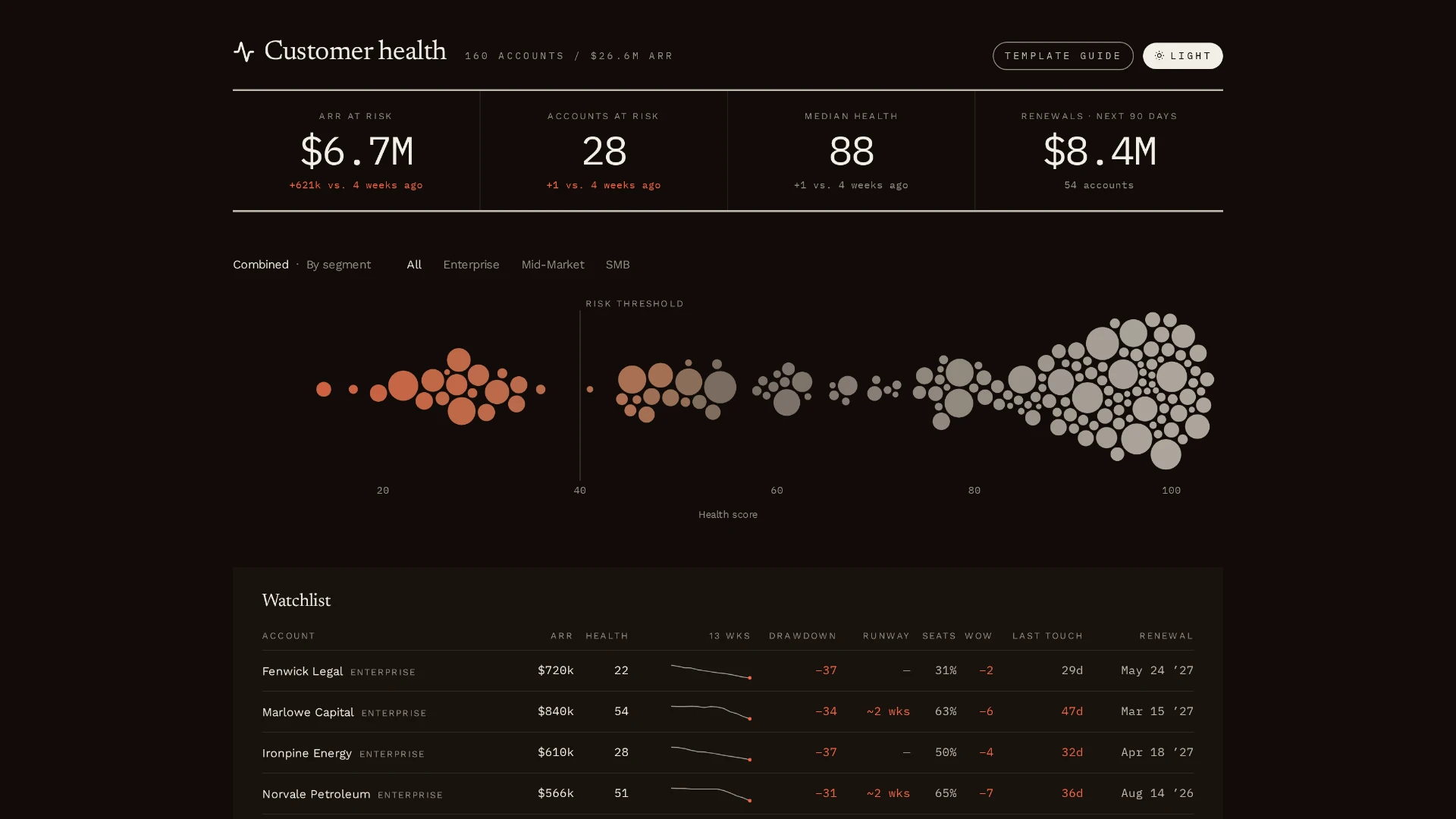
Traditional customer health scores are useful.
But by necessity they reduce complexity.
Perhaps adoption is 30%. Support health is 20%. Relationship strength is 20%. NPS is 10%. Payment status is 10%. Other indicators make up the rest.
The calculation produces:
Health Score: 72. Yellow.
But customers are not equations.
Two customers with identical scores may represent entirely different realities.
Agentic systems can add context.
A decline in utilization might be meaningless for one customer and an early churn signal for another.
A support escalation might indicate dissatisfaction, or it might indicate that a customer is becoming more sophisticated and pushing the product harder.
Low executive engagement may be concerning in one account but completely normal in another.
A new CFO could represent renewal risk. Or an expansion opportunity.
The objective is not simply a more complicated health score.
It is a more contextual understanding of health.
That requires institutional memory, customer-specific intelligence, external signals and human feedback.
Customer A
72Yellow
- Utilization declined — seasonal project completed
- Support contact resolved a complex integration
- Engagement pattern normal for this account
- Renewal on track
Customer B
72Yellow
- Utilization declining 60 days and falling
- Support escalations increasing
- Executive sponsor changed roles
- Cost-reduction program announced
Customers are not equations. The objective is a more contextual understanding of health.
Like the human, the system should learn the customer
Every interaction should make the system better.
When an agent surfaces a signal, the CSM should be able to say:
- Relevant.
- Not relevant.
- Already known.
- Incorrect interpretation.
- Important, but not yet actionable.
- Escalate this.
- Monitor this.
- Revisit in 30 days.
That feedback matters.
So does what happens next.
- Was the intervention successful?
- Did the risk disappear?
- Did the customer expand?
- Was the hypothesis wrong?
- Did an executive escalation help?
- Did the value conversation change the renewal?
- Which signals actually predicted an outcome?
Over time, the system begins developing two important forms of intelligence.
Customer intelligence: an increasingly rich understanding of this particular customer's history, objectives, behaviors, relationships, decisions and patterns.
And institutional intelligence: an understanding of what the organization has learned across customers about retention, growth, value realization and intervention.
The second is particularly powerful.
Today, much of that knowledge walks out the door when experienced employees leave.
An agentic system can help make learning persistent and create context that would otherwise have been incredibly difficult to apply to the situation.
Do not automate the workflow you already have
This may be the most important design principle.
When new technology arrives, organizations naturally ask:
How can we automate what people are doing today?
That is usually the wrong starting point.
If a CSM spends three hours assembling a QBR, the opportunity is not simply to have AI produce the same QBR in ten minutes.
First ask:
- What is the business outcome we aspire to achieve?
- Why does this work exist?
- What outcome are we trying to create?
- What decisions need to be made?
- What jobs need to be done?
- What does the customer and organization actually need?
- What does the CSM need to understand?
- Which activities require human judgment?
- Which require a relationship?
- Which tasks exist only because information is fragmented?
- Which steps are repetitive?
- Which approvals add genuine value?
- Which handoffs exist because our organizational structure requires them rather than because the customer does?
Only then should we decide what the human does, what an agent does, what software does and where they collaborate.
Recent research is increasingly reaching the same conclusion. Harvard Business Review argues that companies frequently fail to generate enterprise-wide AI returns because they automate individual tasks rather than redesign the workflows that create business value. BCG similarly finds that end-to-end process redesign, rather than simply layering AI onto existing work, is what separates organizations capturing transformational value from those achieving incremental gains.[6][7]
The principle is straightforward:
Do not automate the work. Reimagine how the job gets done.
Take low-value, repetitive and machine-appropriate work away from the human.
Then use AI to increase what humans are uniquely capable of doing:
- Exercise judgment.
- Interpret ambiguity.
- Build trust.
- Understand motivation.
- Navigate politics.
- Create alignment.
- Make decisions.
- Influence outcomes.
- And build relationships.
That is not job replacement.
It is job redesign coupled with empowerment.
Move from lifecycle intervention to continuous readiness
Customer Success has traditionally organized much of its work around moments.
- Onboarding.
- 30-day review.
- 90-day review.
- QBR.
- Renewal.
- Executive business review.
- Expansion conversation.
Those moments still matter.
But an intelligent system does not need to wait for the calendar.
It can continuously maintain readiness.
Instead of beginning QBR preparation two weeks before the meeting, the system has been accumulating context since the previous one.
Instead of discovering renewal risk 90 days before contract expiration, it has been evaluating leading indicators throughout the relationship.
Instead of asking the CSM to research the account before an executive meeting, it can identify what has changed as it happens.
Instead of waiting for an expansion conversation, it can recognize when customer needs and demonstrated value begin to create a credible opportunity.
The operating model moves from:
Today: Episodic
toward
Agentic: Continuous
…and back to Observe. The loop never closes for long.
Customer Success becomes less episodic — and more continuously intelligent. Human feedback is required at certain points to ensure that the agents are correctly doing their job.
Customer Success becomes less episodic.
And more continuously intelligent.
Retention is only half of the equation
The business objective is not simply preventing churn.
It is maximizing the value of the customer relationship for both parties.
In subscription businesses, that is reflected in net revenue retention.
McKinsey has described net retention as one of the most important metrics in SaaS and closely connected to efficient growth. More recent research found that companies with sophisticated value realization and adoption practices achieve NRR approximately seven percentage points higher than peers using basic approaches.[1][2]
The customer equation is straightforward:
+7 pp
Companies with sophisticated value realization and adoption practices achieve net revenue retention approximately seven percentage points higher than peers using basic approaches.
Source: McKinsey & Company
Expansion should begin with the value the customer is trying to create — not with what else we can sell.
And the sequence matters.
Expansion should not begin with:
What else can we sell this customer?
It should begin with:
What value is this customer trying to create, what value have we already demonstrated, and where can we credibly help them create more?
That distinction protects trust.
An intelligent system can help uncover those opportunities much earlier.
- A customer enters a new geography.
- Acquires another company.
- Launches a new product.
- Changes leadership.
- Announces a strategic initiative.
- Adds employees.
- Changes operating models.
- Adopts one part of your product deeply while another business unit faces the same problem.
Those are not automatically sales leads.
They are signals.
The Account Manager or CSM determines what they mean in the context of the relationship.
Existing systems still matter
None of this means CRM, Customer Success platforms, product analytics or the rest of the technology stack become irrelevant.
Quite the opposite.
They become important sources of truth and action.
Research from ChurnZero's 2025 Customer Revenue Leadership Study found that customer-data-centric technology, including CRM and Customer Success platforms, was associated with stronger NRR.[3]
The opportunity is not necessarily to create another system of record.
It is to create an intelligence and orchestration layer across the systems of record you already have.
- The CRM knows something.
- The Customer Success platform knows something.
- The product knows something.
- Finance knows something.
- Support knows something.
- The call transcript knows something.
- The open market knows something.
- The CSM knows something.
The intelligence emerges when those things can understand one another.
And then the organization has to change
This is where many AI strategies will succeed or fail.
An agentic Customer Success system is not simply a technology implementation.
It changes work.
- It changes roles.
- It changes expectations.
- It changes decisions.
- It changes information flows.
- It changes management.
- It changes how Customer Success interacts with Sales, Product, Support, Finance, Services and executive leadership.
That requires both top-down and bottom-up change.
Top-down, leaders must establish the business outcomes, redesign principles, governance, decision rights and willingness to change existing operating models.
They must make clear that the objective is not to sprinkle AI across the organization and count hours saved.
The objective is business impact.
- Higher retention.
- Greater demonstrated customer value.
- More expansion.
- Earlier intervention.
- Better decisions.
- Higher NRR.
And potentially step-change improvements in how effectively the organization operates.
Bottom-up, the people doing the work must help design the system.
CSMs and Account Managers know where information breaks down.
- They know which tasks consume time without creating customer value.
- They know which signals are meaningful.
- They know where judgment matters.
- They know which escalations work.
- They know where playbooks fail.
And they will ultimately determine whether the agents become trusted collaborators or another system employees learn to work around.
This is why change management cannot be something added after the agents are built.
The people who do the work need to help redesign the work.
BCG's long-standing AI transformation framework makes the point quantitatively: roughly 10% of transformation effort should focus on algorithms, 20% on technology and data, and 70% on people and processes. Its 2026 Applied AI Index also found that companies combining strategic clarity with strong applied-AI execution generate roughly five times the value from AI as companies weak in both.[7][8]
The ambition should therefore be much greater than productivity.
Saving 20% of a CSM's administrative time is useful.
But what happens if the redesigned operating model allows that CSM to understand every customer more deeply?
- Recognize meaningful risk months earlier?
- Demonstrate value more consistently?
- Maintain stronger executive relationships?
- Manage a larger portfolio without degrading customer intimacy?
- Identify credible expansion opportunities sooner?
- Mobilize the organization faster when intervention is required?
- Make materially better decisions?
That is where the potential moves from incremental efficiency toward multiples of business impact.
The target should not be:
How do we make today's Customer Success organization 20% more efficient?
It should be:
What would we design differently if humans and agents were working together from the beginning?
Guardrails matter
More intelligence and autonomy also create risk.
Agents should not independently make consequential customer decisions simply because they can.
Different agents require different permissions.
Research may be autonomous. Meeting preparation may be autonomous. Signal detection may be autonomous. Drafting may be autonomous. Updating certain records may be autonomous.
But pricing decisions, contractual commitments, executive escalations, sensitive communications or material changes to a customer relationship may require explicit human approval.
The architecture should define:
- What an agent can observe.
- What it can infer.
- What it can recommend.
- What it can prepare.
- What it can execute.
- What requires approval.
- What requires escalation.
- What must always remain human.
McKinsey's work on agentic customer experience similarly emphasizes designing around decisions rather than simply automating steps, establishing clear human-agent ownership and escalation rules, and keeping consequential actions reversible with humans able to override the system.[9]
Agent-autonomous
- Research
- Renewal/expansion planning scenarios
- Signal detection
- Drafting
- Updating certain records
Requires human approval
- Pricing decisions
- Contractual commitments
- Executive escalations
- Sensitive communications
- Material relationship changes
Guardrails are not an obstacle to agentic systems. They are what allow us to trust them.
Guardrails should not be an obstacle to agentic systems.
They are what allow us to trust them.
Measure business impact, not agent activity
A final trap will be measuring the technology rather than the outcome.
- How many agents did we deploy?
- How many prompts did employees send?
- How many tasks did AI complete?
- How many hours did we save?
Those may be useful operational measures.
They are not the business case.
For Customer Success, the scorecard should ultimately connect to outcomes such as:
- Gross retention.
- Net revenue retention.
- Expansion.
- Renewal predictability.
- Time to value.
- Product adoption.
- Value realization.
- Executive engagement.
- Portfolio capacity.
- Risk identification lead time.
- Intervention effectiveness.
- Customer experience.
And the amount of customer-facing time returned to relationship owners.
BCG's latest research makes a similar point at the enterprise level: organizations that connect AI measurement directly to P&L outcomes or business KPIs realize materially greater value than those that do not formally measure business impact.[8]
The objective is not more AI activity. It is better customer economics.
Before it matters most
Customer Success was created because recurring revenue changed the economics of the customer relationship.
Winning the customer was no longer enough.
You had to keep earning the relationship.
That remains true.
What changes in the agentic era is our ability to understand that relationship.
For the first time, we can imagine a system capable of continuously examining the enormous amount of information surrounding every customer, preserving institutional context, identifying meaningful changes and bringing intelligence to the relationship owner at exactly the moment it becomes useful.
Not after the customer says they are leaving.
Before.
Not after the executive sponsor disengages.
Before.
Not when the renewal opportunity opens.
Before.
Not after the customer asks what value they received.
Before.
Not after a competitor gains a foothold.
Before.
Not after an expansion opportunity becomes obvious.
Before.
That does not diminish the role of the Account Manager or Customer Success Manager.
It makes the human relationship more important.
Because the purpose of an agentic Customer Success strategy should not be to automate the relationship.
It should be to automate and augment everything around the relationship so the human can understand the customer more deeply, exercise better judgment, act earlier and spend more time building it.
That is the opportunity.
Not another chatbot.
Not another dashboard.
Not another layer of automation.
Intelligence before it matters most.
Sources & Further Reading
1. McKinsey & Company. Net retention and customer success: Gainsight CEO Nick Mehta on winning at SaaS. Discussion of net retention, value realization, leading indicators and the role of Customer Success in retention and expansion.
2. McKinsey & Company. The Net Revenue Retention Advantage: Driving Success in B2B Tech. Research on the practices associated with NRR outperformance, including sophisticated value realization and adoption journeys.
3. ChurnZero and partners. 2025 Customer Revenue Leadership Study. Research on Customer Success, customer revenue organizations, technology adoption, AI and NRR.
4. Gainsight and Benchmarkit. Customer Success Index. Research on AI adoption in Customer Success, including early warning systems, customer insights and administrative time savings.
5. Salesforce. State of Service, Seventh Edition. Research on AI-enabled service work, including reductions in routine work and greater time devoted to complex customer issues.
6. Harvard Business Review. Stop Automating Old Processes. Design New Ones Instead. Research and analysis on why automating individual tasks within existing processes can fail to produce enterprise-level AI returns.
7. Boston Consulting Group. AI-First Enterprise Operations: Reinventing the Operating System of Work and Scaling AI Requires New Processes, Not Just New Tools. Research on end-to-end process redesign, agentic operating models and organizational change.
8. Boston Consulting Group. The Formula for Agentic AI Value: The Applied AI Index 2026. Research on strategic clarity, applied AI, business-value measurement, governance and organizational readiness.
9. McKinsey & Company. Rewiring Customer Experience for the Agentic Era. Framework for redesigning customer workflows around decisions, shared context, human-agent ownership, escalation and reversible actions.
Written by
Frank Ricciardi
Founder & Principal Advisor, FARVENTURES