

The Operator Beside the CEO: Rethinking the Chief of Staff for Start-ups and Scale-ups
Why putting a deeply experienced operator beside the CEO can create a powerful source of leverage for start-ups and scale-ups.

Frank Ricciardi
Founder & Principal Advisor
There comes a point in the evolution of almost every successful start-up when the CEO becomes a constraint on the company they created.
Not because they are ineffective. Often, it is precisely the opposite.
The company has grown. Customers need attention. Investors need communication. The leadership team needs alignment. New markets are emerging. Important hires need to be made. Strategic partnerships are developing. The board has expectations. Culture needs reinforcement. And somewhere among all of this, someone still has to think about what comes next.
The CEO's priorities begin to exceed the organization's capacity to execute them.
This is one of the moments when a Chief of Staff can become extraordinarily valuable.
But I believe many companies think about the role incorrectly.
The Chief of Staff is often treated as a developmental role for a talented, high-potential professional who gains exposure to the CEO before moving into an operating position elsewhere in the company.
That can be an excellent model.
But for start-ups and scale-ups navigating periods of rapid growth, transformation or complexity, there is another model worth considering:
Instead of hiring someone who wants to learn how executives operate, put an experienced operator beside the CEO.
Someone who has already sat in the CEO or CXO chair.
The difference can be profound.
The Chief of Staff is not an executive assistant
Let's start with what the role is not.
A Chief of Staff should not simply be another layer of calendar management, meeting coordination and administrative support. Those functions are important, but they are fundamentally different from the strategic purpose of the role.
Harvard Business Review has described the Chief of Staff through roles including air traffic controller, integrator, communicator, honest broker and confidant. McKinsey similarly describes the fundamental purpose as enabling the principal, usually the CEO, to execute their mission.
Recent research suggests the influence runs even deeper.
A study drawing on 2,500 LinkedIn profiles, surveys of 108 Chiefs of Staff and interviews with 13 found that Chiefs of Staff can exert substantial influence on CEO decision-making. They act as sounding boards, filter information, connect the top management team and help translate strategic vision into execution. Importantly, only 3.9% of the Chiefs of Staff in the LinkedIn dataset had previously been executive assistants.
This is a strategic leadership role.
And in a growth company, I would define its purpose even more simply:
A great Chief of Staff increases the operating leverage of the CEO.
There is no single Chief of Staff archetype
This distinction matters because the title itself can be misleading.
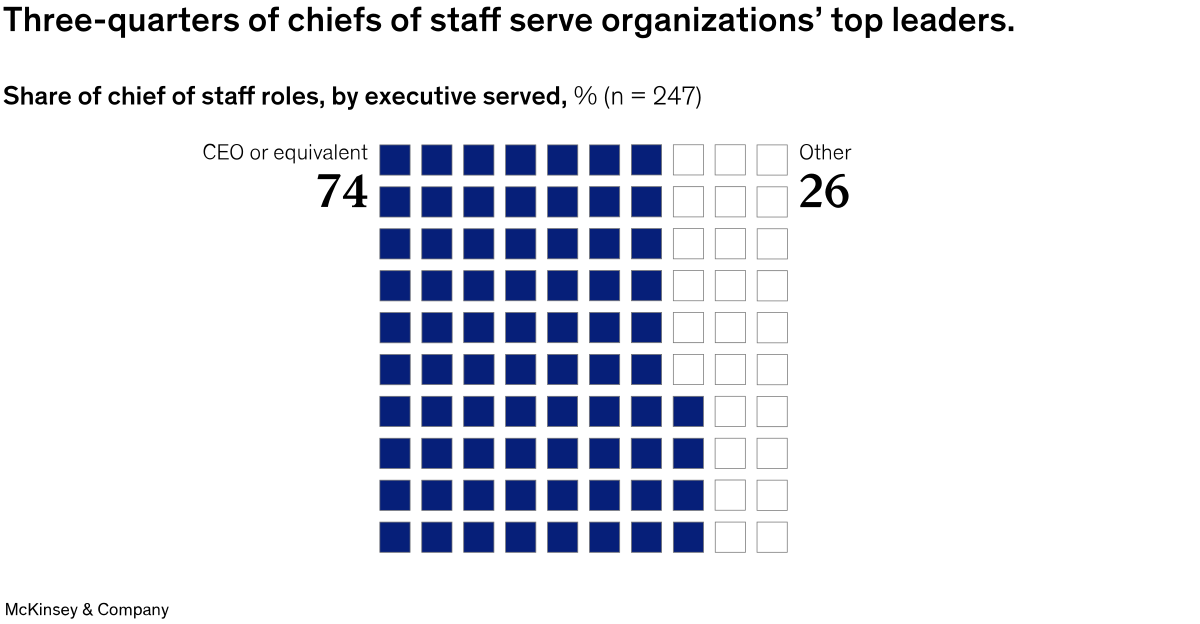
McKinsey analyzed approximately 250 Chiefs of Staff who had served in the role during an eight-year period and found considerable variation in their experience, responsibilities and career trajectories.
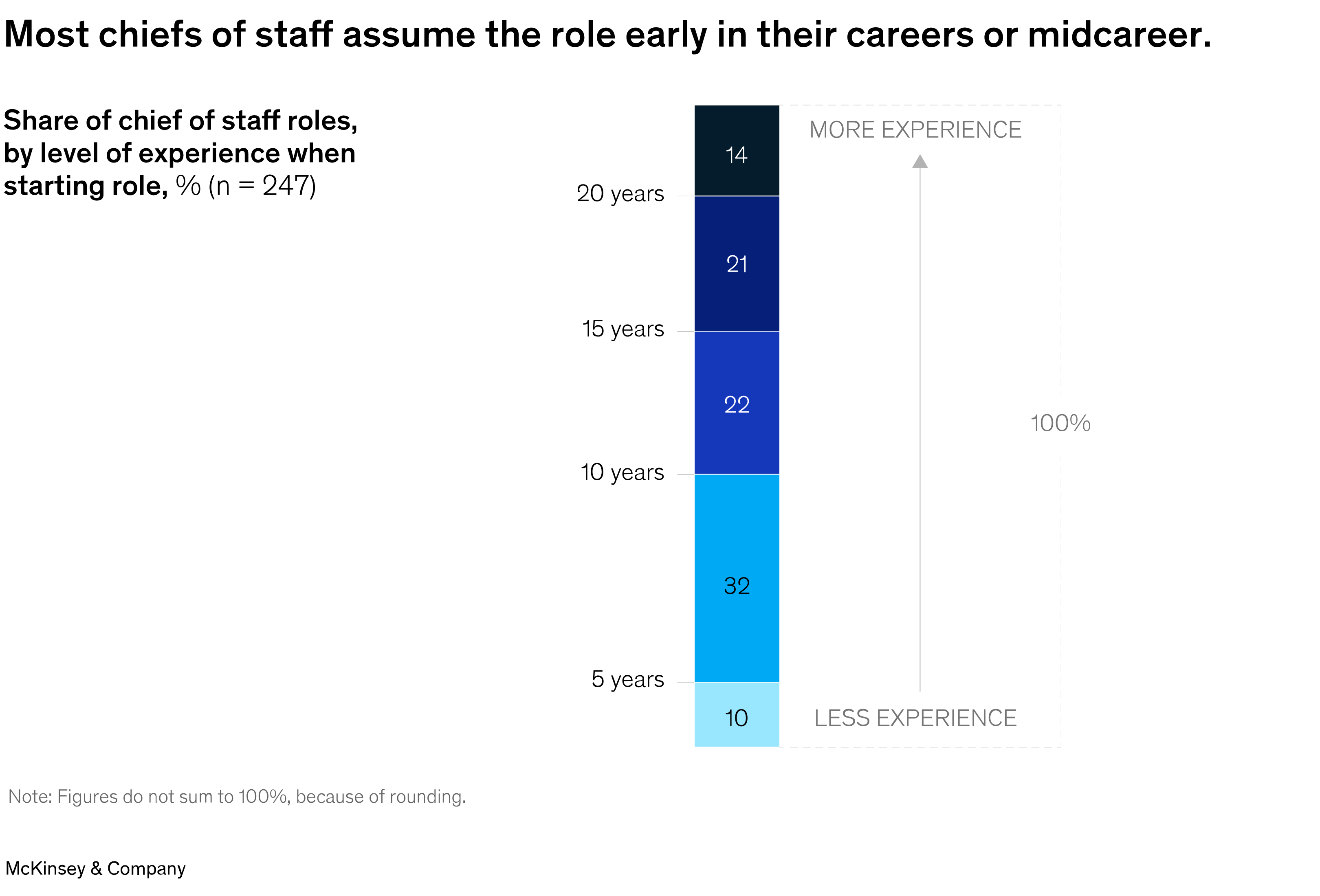
The average Chief of Staff in its analysis had just over 12 years of professional experience, but McKinsey identified two distinct career points at which people commonly enter the role. Those with five to ten years of experience tend to focus more heavily on administrative responsibilities, corporate governance, KPI tracking, board preparation and projects run from the principal's office. Midcareer executives with ten to 20 years of experience tend to assume greater leadership responsibility and may serve as the principal's proxy in discussions and decisions.
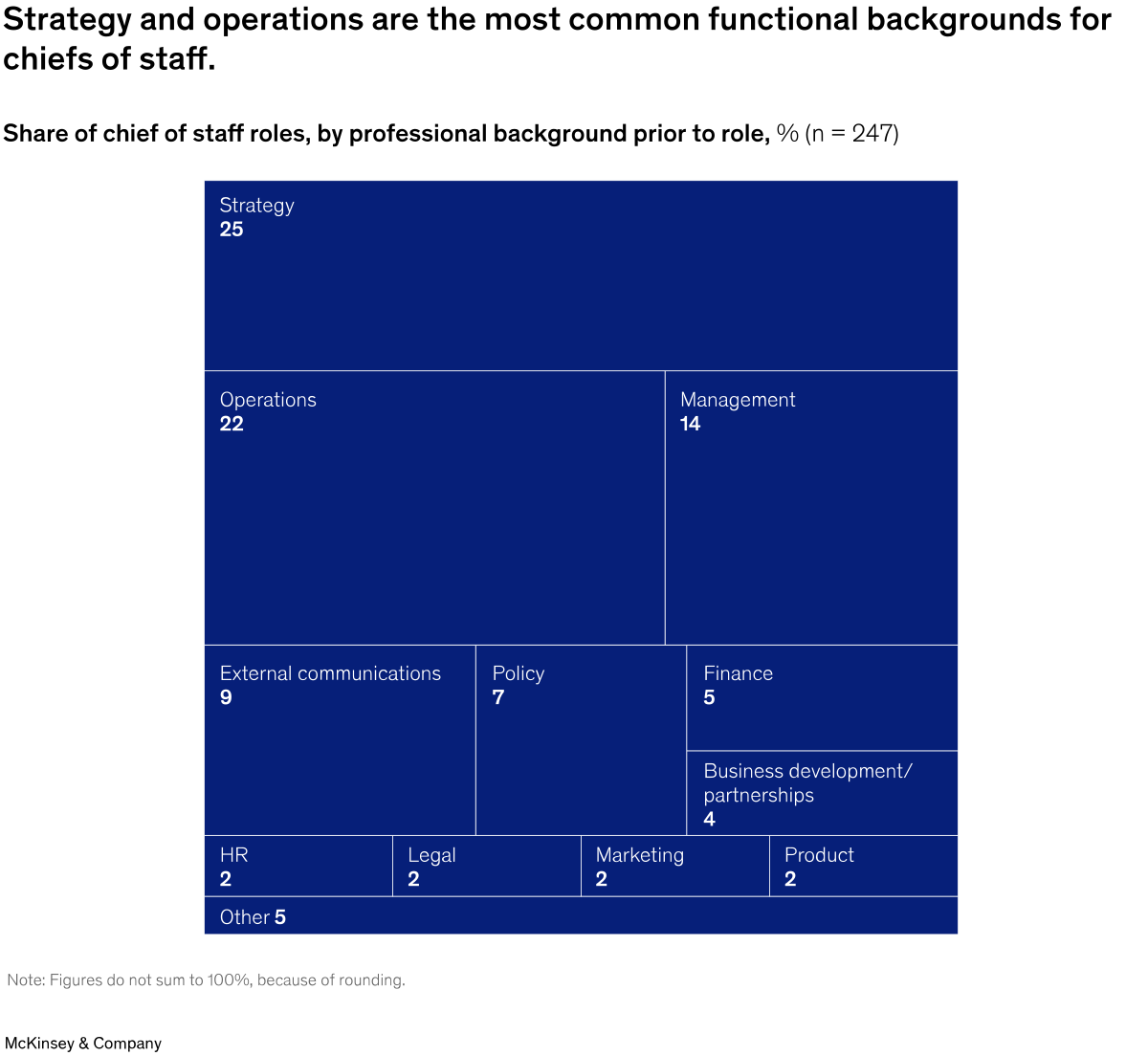
McKinsey also found strategy and operations to be the most common functional backgrounds, representing roughly half of its sample. The reason is instructive: the Chief of Staff frequently needs to handle a wide range of assignments and understand enough about how the business operates to move effectively among them.
That versatility is not incidental to the role. It is one of its greatest sources of value.
The value is not staying in one lane
Most executives are hired to own a lane.
The CFO owns finance. The CRO owns revenue. The CPO owns product. The CHRO owns people.
The Chief of Staff is different.
Part of the value of the role is precisely that the Chief of Staff does not stay in one lane.
On Monday, the priority might be preparing for a board discussion. On Tuesday, it might be resolving friction between Product and Sales. Wednesday could involve pressure-testing an international expansion strategy. Thursday might mean helping redesign the executive operating cadence. By Friday, the CEO may need someone to take ownership of an important initiative that crosses three functions and has no obvious organizational home.
That is not role ambiguity. Done well, it is role design.
The Chief of Staff operates horizontally in an organization that is largely structured vertically.
That horizontal vantage point matters because many of the hardest problems in a scaling company do not respect organizational boundaries. They occur between functions, across priorities, and in the gap between a decision and its execution.
A strong Chief of Staff has the permission, range and judgment to move wherever the CEO's most important priorities require.
For an experienced operator, that range can become even more powerful. Someone who has led across functions, geographies, customers, operating models or stages of growth can move into an unfamiliar problem without needing to become its permanent functional owner.
The question is not, Is this in my lane?
The question is, Is this important to the mission, and how do we get it done?
Why the role becomes particularly powerful in a scale-up
Early-stage companies can run remarkably well through informal systems.
Five people can sit around a table. Twenty people can operate largely through relationships. The founder can personally participate in most consequential decisions.
Success eventually breaks that model.
Functions form. Management layers appear. The number of decisions increases. Information becomes distributed across the organization. Dependencies multiply. Priorities compete. And initiatives increasingly cross functional boundaries.
What once happened naturally now requires an operating system.
This is where CEOs frequently become accidental bottlenecks.
Decisions wait for them.
Teams interpret priorities differently.
Executive meetings generate discussion without sufficient follow-through.
Strategic initiatives fall between functional owners.
Information arrives without context.
And the CEO gets pulled progressively further into the machinery of the business at exactly the moment when the company most needs them thinking about customers, capital, talent, strategy and the future.
Andreessen Horowitz describes the evolution clearly. In smaller companies, the CoS may concentrate primarily on the executive. As organizations scale, the role increasingly shifts toward leadership-team effectiveness, operating cadence, accountability and cross-functional alignment. In hypergrowth, the role can extend into organization design, governance, business capabilities and optimization of how the company itself operates.
This is not about giving the CEO another pair of hands.
It is about giving the CEO leverage.
What does that leverage actually look like?
A strategic Chief of Staff operates in the space between strategy and execution.
The CEO says, these are the five things that matter.
The Chief of Staff helps make sure the organization behaves accordingly.
That can mean establishing the operating cadence through which priorities are reviewed and decisions are made. It can mean driving accountability against OKRs and ensuring that leadership meetings produce decisions, owners and outcomes rather than another meeting.
It means connecting functions when an important initiative does not fit neatly inside Sales, Product, Finance, Marketing or Operations.
It means synthesizing information before it reaches the CEO so that the executive is making decisions rather than spending scarce time reconstructing context.
It means identifying emerging risks, organizational friction and execution gaps before they become CEO-level problems.
It means ensuring that a strategic decision made on Monday actually changes what the organization does on Tuesday.
And sometimes it means taking direct ownership of a mission-critical initiative until the organization develops the permanent capability to own it.
McChrystal Group describes the Chief of Staff as a force multiplier who bridges leadership and execution, orchestrates cross-functional collaboration and translates executive vision into the practical reality in which the organization operates.
That is much closer to the role I believe growth companies should be designing.
Now put a deeply experienced operator in that seat
This is where I think the model becomes particularly interesting.
What happens when the person sitting beside the CEO brings not five or ten years of professional experience, but decades of it?
Someone who has already sat in CEO and CXO seats.
Someone who has built and scaled organizations, managed a P&L, hired and developed executives, stood in front of boards, owned a number, missed a number, navigated crises, entered new markets and experienced firsthand what happens downstream when an executive makes a seemingly simple decision upstream.
They know that organizational design looks elegant on PowerPoint and considerably messier when human beings are involved.
Most importantly, they know what it feels like to sit in the chair.
At that point, the Chief of Staff role becomes something different.
You are not primarily adding capacity. You are adding accumulated pattern recognition, operating judgment and executive perspective to the CEO's office.
That experience changes the conversation.
An experienced operator can challenge the CEO not simply from analytical knowledge, but from pattern recognition.
"I've seen this before."
"That initiative doesn't have an owner."
"We're calling this a strategy problem, but I think it is actually an accountability problem."
"If these are really our three priorities, why are we funding seven?"
"We made the decision three weeks ago. Why hasn't anything changed?"
That is a very different kind of leverage.
From force multiplier to judgment multiplier
CEO bandwidth is usually discussed as a problem of time.
I think that understates the issue.
The scarcest resource in a scaling company is often not the CEO's time. It is the CEO's attention and judgment.
A CEO can theoretically attend another meeting. The more important question is whether they should.
A strong Chief of Staff helps protect that scarce resource by improving the information, context and organizational machinery surrounding executive decisions.
An operator-grade Chief of Staff can go further because they bring independent executive judgment to the equation.
They can recognize which issues truly require the CEO.
They can distinguish signal from organizational noise.
They can anticipate the second- and third-order consequences of decisions.
They can challenge assumptions without needing the authority of a functional empire.
And because they sit across the organization rather than inside a particular silo, they can sometimes see patterns that individual executives cannot.
Research into the role describes Chiefs of Staff as unusually influential despite frequently operating outside the formal top-management structure. They help shape CEO sensemaking while simultaneously acting as connective tissue across the leadership team.
That combination of proximity, context and experience can make the role an extraordinary source of executive leverage.
But the Chief of Staff is not the COO
This distinction matters.
A COO typically owns a significant part of the company's operating organization. People, budgets and functions report into that executive.
A Chief of Staff generally works through the existing organization rather than replacing it.
The best CoS should strengthen executives, not compete with them.
The CRO still owns revenue.
The CFO still owns finance.
The CPO still owns product.
The Chief of Staff helps ensure that the company's most important priorities survive the spaces between those functions.
That makes influence without authority one of the defining capabilities of the role.
It also explains why executive experience can be so valuable. Someone who has led functions themselves understands the difference between helping an executive succeed and inadvertently stepping into their job.
The objective is not to create a shadow management team.
It is to make the existing management team work better.
When should a CEO consider one?
There is no magic employee count or funding round.
The better diagnostic is organizational complexity.
You probably do not need a Chief of Staff because you are busy. Every CEO is busy.
The role becomes strategically interesting when the CEO's bandwidth is becoming a constraint on organizational performance.
Some of the signals are easy to recognize:
- The same strategic priorities appear in meeting after meeting without moving fast enough.
- Important initiatives cross several functions but have no natural owner.
- Leadership meetings consume substantial time but produce inconsistent accountability.
- Decisions repeatedly return to the CEO because the organization lacks clarity.
- Executives are individually performing but insufficiently aligned as a leadership team.
- The CEO is spending too much time coordinating the business and too little time advancing it.
- The organization needs capabilities or operating discipline that do not yet justify another permanent C-suite function.
Those are not administrative problems.
They are leverage problems.
There is also a case for the fractional model
For start-ups and scale-ups, this creates another interesting possibility.
The company may need executive-level leverage before it needs another full-time executive.
A fractional Chief of Staff can be particularly useful during inflection points: a financing round, international expansion, leadership transition, restructuring, acquisition, new-market entry, strategic planning cycle or period of rapid scaling.
The mandate can be explicit.
Build the operating cadence.
Establish the OKR system.
Align the executive team.
Drive these three strategic initiatives.
Create the governance model.
Build the capability.
Then determine what the company needs next.
That may ultimately be a permanent Chief of Staff. It may be a COO. It may be another functional executive. Or the organization may simply become capable of absorbing the work itself.
Fractional does not have to mean junior, temporary help.
Done correctly, it can mean injecting precisely the executive capability required at precisely the moment the organization needs it.
The paradox of the role
There is something unusual about a great Chief of Staff.
Their impact can be enormous while their visibility remains relatively low.
They make the CEO better without trying to become the CEO.
They strengthen executives without taking ownership away from them.
They create accountability without necessarily possessing formal authority.
They move between strategy and execution, boardroom and operating meeting, today's crisis and tomorrow's opportunity.
And they succeed when the organization succeeds.
For start-ups and scale-ups, that may be exactly why the role deserves more attention.
The next important executive hire does not always need another function to lead.
Sometimes what the CEO needs most is an experienced operator beside them who can see the whole board, challenge their thinking, move across the organization where needed, align the leadership team and help turn priorities into outcomes.
Not another layer of management.
Leverage.
Written by
Frank Ricciardi
Founder & Principal Advisor, FARVENTURES